Free Online Antique Price Guide: How to Value Your Treasures in 2026

Is It Trash or Cash?
You've just found an interesting old vase in the attic, or perhaps you bought a unique chair at a garage sale for ten dollars. Now, the big question hits you: Is this trash, or is it cash?
Finding the true value of an antique used to require hauling heavy items to a stuffy auction house. Today, you can access a free online antique price guide from the comfort of your living room. However, not all guides are created equal. To get an accurate number, you need to know where to look and, more importantly, how to interpret what you find.
Here is your step-by-step guide to using free online resources to unlock the value of your antiques.
The Golden Rule: Asking Price vs. Sold Price
Before you start your antique value lookup, you must understand the most common mistake beginners make.
If you search for your item and see a seller on eBay asking $500 for it, that does not mean your item is worth $500. Anyone can ask for any price they want. The only number that matters is what a buyer actually paid.
💡 Remember This:
- Asking Price: A wish. (Ignore this).
- Sold Price: The reality. (Focus on this).
Top Free Antique Identification and Value Tools
There is no single "magic book" that lists the price of every item in the world, but there are powerful free tools that act as excellent antique price guides.
1. eBay "Sold" Listings
eBay is arguably the world's largest database of antique market values. It represents what real people are paying right now.
How to use it: Search for your item (e.g., "1920s Art Deco lamp"). On the sidebar filters, scroll down and check the box that says "Sold Items". The prices will turn green. This is the true market value.
Pro Tip: You can also filter by "Completed Listings" to see items that didn't sell. If many similar items are listed but not selling, it means the market is saturated or the asking prices are too high.
2. Google Lens (Reverse Image Search)
Sometimes you can't look up a price because you don't even know what the item is. This is where antique identification comes first.
How to use it: Open the Google app on your phone and tap the camera icon (Google Lens). Snap a photo of your item. Google will visually match it to other images on the web. This often leads you to auction sites or collector forums where the item is named and valued.
Note: While Google Lens is helpful for general identification, specialized antique identification apps provide more detailed historical context and accurate valuations specific to the antiques market.
3. LiveAuctioneers & Invaluable (Auction Results)
For higher-end items (fine art, rare furniture, porcelain), eBay might not be enough. Sites like LiveAuctioneers allow you to view past auction results.
How to use it: You typically need to create a free account. Once logged in, you can search their "Past Auctions" database. This is essential for an accurate antique appraisal online free of charge for clearer, high-ticket items.
⚡ Skip the Research—Get Instant Valuations
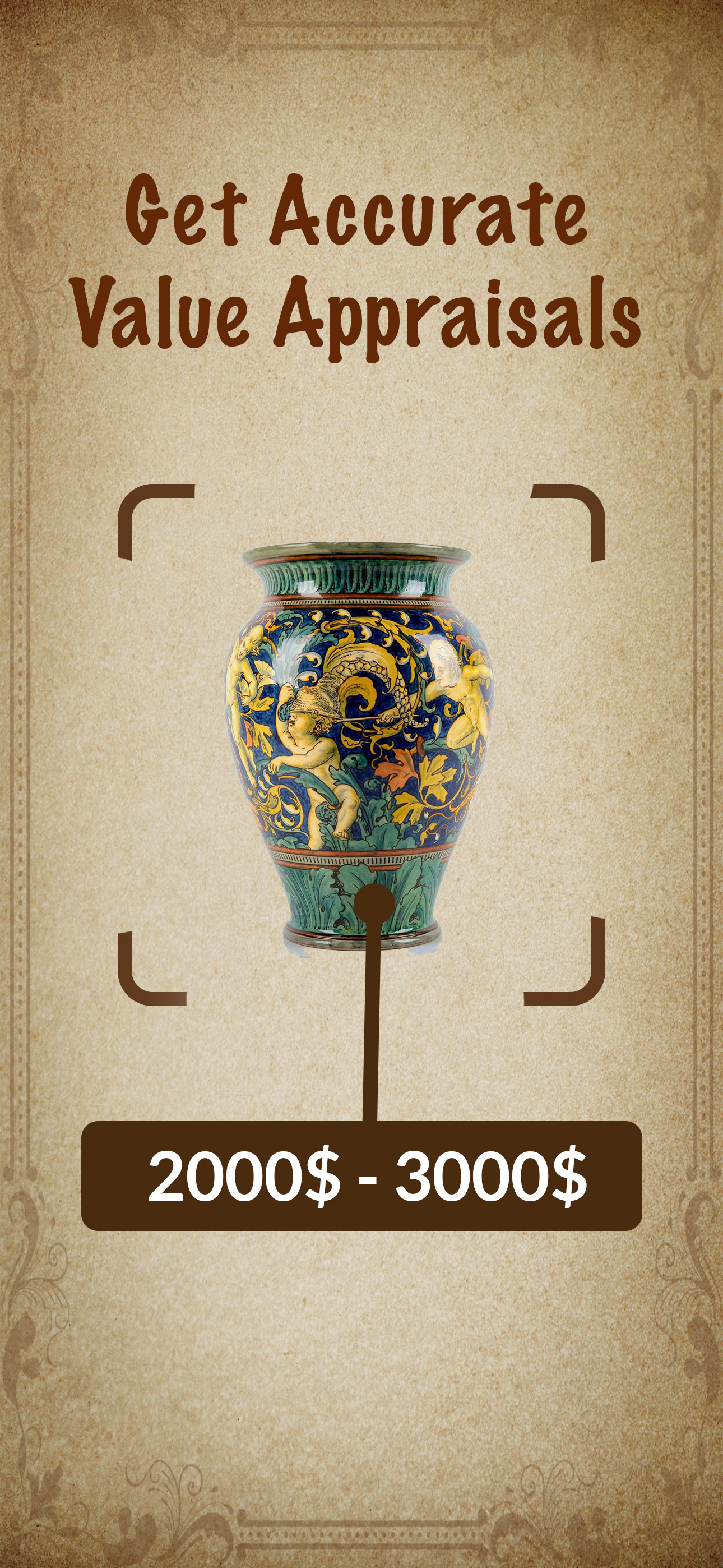
Why spend hours comparing sold listings when you can get instant, accurate valuations? Relico combines AI technology with comprehensive antique databases to deliver professional-grade appraisals in seconds.
- 📸 Snap & Identify: Just take a photo and get instant results
- 💰 Market Value Ranges: Based on actual sold prices, not wishful thinking
- 📚 Historical Context: Learn the story behind every piece
- 🎯 Authentication Help: Spot reproductions and fakes
Perfect for: Estate sales, flea markets, online shopping, or evaluating your collection
🎁 Start Your Free 3-Day Trial—No Credit Card Required
⭐ Rated 4.8/5 by antique enthusiasts and professional dealers
Step-by-Step: How to Value Your Antique
Ready to find the number? Follow this workflow to ensure accuracy.
Step 1: Inspect for Marks
Turn your item over. Look for a maker's mark, a signature, a serial number, or a country of origin stamp. A silver spoon with a "Lion Passant" stamp is worth significantly more than one marked "EPNS" (Electro-Plated Nickel Silver).
Common Marks to Look For:
- • Stamped logos or initials on pottery, ceramics, and porcelain
- • Hallmarks on silver (925, Sterling, Lion Passant)
- • Signatures on paintings and prints
- • Labels or branded marks on furniture
- • Patent numbers or dates on vintage items
Step 2: Assess the Condition
Be honest. Does your item have chips, cracks, or rust? In the antique world, condition is everything. A mint-condition comic book might be worth $10,000, while the same book with a torn cover might be worth $100. When comparing your item to online prices, match the condition strictly.
Condition Scale:
- Mint: Like new, perfect condition—highest value
- Excellent: Minor signs of wear, no structural damage
- Good: Visible wear, minor repairs, but presentable
- Fair: Noticeable damage, may need restoration
- Poor: Severely damaged, missing parts—lowest value
Step 3: Find "Comps" (Comparables)
Use the tools mentioned above to find at least three items that sold recently.
Example Calculation:
- Sold Item A: $120
- Sold Item B: $110
- Sold Item C: $150
- Your Estimate: Roughly $125
The more comparables you find, the more accurate your estimate will be. Look for items that match not just the type, but also the age, condition, maker, and size.
When Should You Pay for an Appraisal?
While a free antique price guide is great for items under $500, there are times you should call a professional. If you suspect you have a rare painting, a piece of diamond jewelry, or an item with significant historical provenance, do not rely solely on Google.
Professional appraisers provide certified documents that are required for insurance purposes—something a free online search cannot give you.
When to Get a Professional Appraisal:
- • Items potentially worth over $1,000
- • Insurance documentation needed
- • Estate settlement purposes
- • Tax deduction for charitable donations
- • Legal disputes or divorce settlements
- • Authentication of high-value artwork or collectibles
Look for certified appraisers from organizations like the American Society of Appraisers (ASA) or the International Society of Appraisers (ISA). Expect to pay between $100-$300 per hour, depending on the appraiser's expertise and your location.
Common Valuation Mistakes to Avoid
1. Overvaluing Based on Sentimental Attachment
Your grandmother's china might be priceless to you emotionally, but if similar sets are selling for $50 online, that's the market value. The market doesn't care about your memories—it only cares about supply, demand, and condition.
2. Ignoring the "Comparables" Rule
Don't cherry-pick the highest price you find and assume your item is worth that. Look at the average of multiple sold items in similar condition.
3. Confusing Retail Price with Resale Value
Just because something costs $200 new doesn't mean it will sell for $200 used—even if it's in perfect condition. Most items depreciate unless they're true antiques or highly collectible.
4. Not Accounting for Seller Fees
If you're planning to sell on eBay, Etsy, or through an auction house, remember they take a cut (usually 10-20%). Factor this into your final valuation.
Maximizing Your Antique's Value
Clean Carefully (or Don't Clean at All)
For most antiques, do not clean them before getting them appraised or selling them. Over-cleaning can remove valuable patina and decrease value. Collectors often prefer items in their original state.
Exception: Gentle dusting is usually safe. For anything beyond that, consult an expert first.
Document Your Item's History
If you have documentation showing where the item came from (a receipt, a letter, a photo of it in your grandparents' home in 1950), this adds provenance—which can significantly increase value.
Choose the Right Sales Channel
Where you sell matters:
- eBay: Best for mid-range items ($50-$500) with broad appeal
- Etsy: Great for vintage décor and jewelry
- Specialized Auction Houses: For high-end or rare items
- Facebook Marketplace/Craigslist: Good for large furniture (avoids shipping)
- Antique Dealers: Quick cash, but expect to get 40-60% of retail value
Conclusion
Uncovering the value of your old items is a treasure hunt. By using sold listings and visual search tools, you can instantly become your own appraiser. Start digging through those boxes—you never know when a dusty old trinket might turn out to be a hidden fortune.
The key is to be methodical: identify your item, assess its condition honestly, find real sold prices (not asking prices), and make an informed decision. Whether you're cleaning out your attic or browsing estate sales, knowledge is your most valuable tool.
💎 Final Expert Tip
Need to identify a tool or coin quickly? Modern identification apps like Relico combine the convenience of Google Lens with the accuracy of professional antique databases. Scan, identify, and get instant valuations—all from your phone. Check out the latest features designed to help you scan and identify your collection in seconds.
Remember: The antique market is constantly changing. What's hot today might cool off tomorrow. Stay informed, keep learning, and enjoy the journey of discovery. Happy treasure hunting!